Zip Screen Guide: Wind-Resistant Exterior Blinds for Every Facade
Learn what zip screens are, how they work, and why they're ideal for UV blocking, privacy, energy savings, and wind resistance up to 50+ km/h.
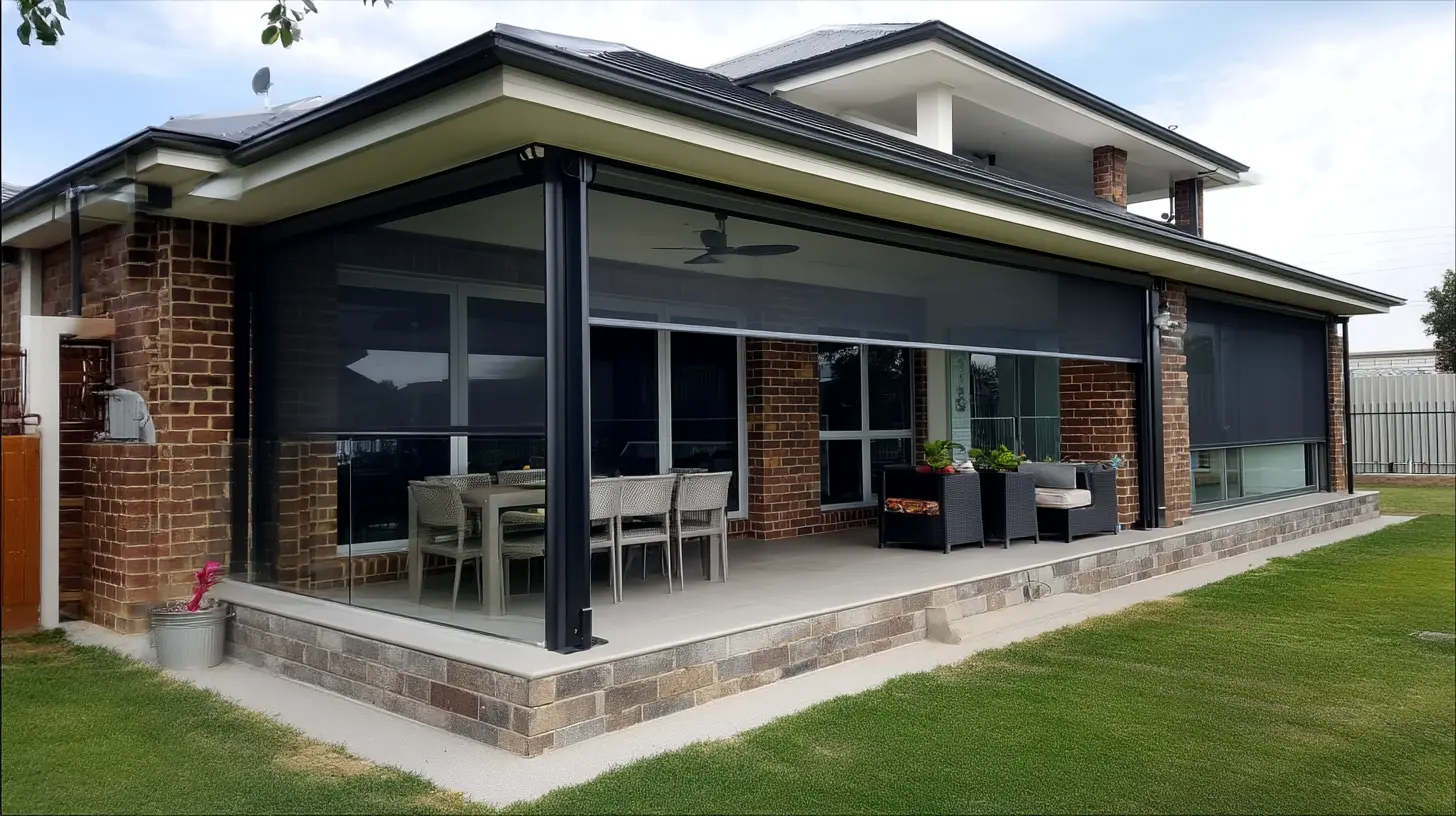
A zip screen is a modern exterior shading system that combines daylight control, UV protection, and wind resistance in a single motorised or manual solution. This guide explains how they work, what openness factor means, how to choose the right fabric, and why architects and homeowners across Europe increasingly specify them.
What is a Zip Screen?
A zip screen — also known as a Senkrechtmarkise or Textilscreen in German-speaking markets, ritsscreen in the Netherlands, and store zip in France — consists of a mesh or fabric blind suspended in aluminium guide rails (known as "zip tracks") that run vertically along the sides of a facade, window, pergola, or balcony. The fabric is tensioned and guided by these tracks, allowing it to move smoothly up and down without flapping or billowing — even in strong wind.
The name "zip screen" comes from the zip-track technology that keeps the fabric edges sealed against the guides, similar to a zipper mechanism. This sealed edge is what distinguishes zip screens from conventional roller blinds: the fabric cannot escape the track, giving the system its characteristic wind resistance and preventing insects from entering the space behind the screen.
How Zip Screens Work
Guide Rails: Vertical aluminium U-channels run along both sides of the window or facade. The fabric edges slide inside these channels with minimal friction. The channel profile typically measures 30–50mm wide and can be surface-mounted or recessed into the facade for a flush aesthetic.
Zip Mechanism: A continuous plastic or rubber zip strip runs along both edges of the fabric, interlocking with the guide rail channel. This creates a sealed perimeter that prevents the fabric from pulling out under wind load. High-quality systems like the Luxa 100 use reinforced Plastex zip components rated for 130 km/h wind resistance.
Tension: The fabric remains taut at all times because of the guides. There is no sagging, twisting, or flapping — even gusts up to 130 km/h pass around the fabric harmlessly on the best systems.
Motorisation (Optional): Motorised zip screens (like the Luxa 100) use a quiet tubular motor concealed in the top cassette to raise or lower the fabric. Manual systems (Luxa 100M) use a hand crank with a gear mechanism. Both can include wind and sun sensors for full automation. The Luxa 100S solar variant integrates a photovoltaic panel and battery, requiring no electrical wiring whatsoever.
Understanding Openness Factor — the Most Important Fabric Specification
The openness factor (OF) is the single most important number when choosing a zip screen fabric. It measures the proportion of open area (holes) in the weave, expressed as a percentage. A lower openness factor means a tighter weave with smaller holes — less light passes through, but so does less heat and glare.
How openness factor is measured: The OF is determined by directing light rays through the fabric and measuring how much passes through the holes (not through the material itself). It is measured using the darkest colour in a fabric range, because lighter colours allow slightly more light transmission through the material itself. The OF is considered independent of colour for the same weave pattern.
Openness Factor Comparison Table
Key insight: The difference between 1% and 3% openness is much more significant than the numbers suggest. In the updated EN 14501:2021 standard, dark-coloured 1% fabrics now achieve glare control Class 4 (very good effect), while 3% fabrics of the same colour typically reach Class 3 (good effect). In environments where screen readability matters — classrooms with smartboards, offices with computer monitors — this one-class difference can be the deciding factor.
How Openness Factor Affects Daily Experience
Daytime view outward: With a 3% or 5% screen, you can see the garden, street, or landscape clearly. Objects are visible, colours are recognisable, and depth perception is maintained. A 1% screen still allows a view, but it is more muted — you see silhouettes and shapes rather than sharp detail. Think of it as looking through a fine mesh rather than tinted glass.
Daytime privacy inward: From outside, a person looking at a zip screen during the day sees a near-opaque surface regardless of openness factor. The brightness difference between the sunny exterior and the darker interior makes the screen appear solid. Even a 10% screen provides effective daytime privacy.
Night-time privacy: This is where openness factor matters most for residential use. When interior lights are on and the exterior is dark, the brightness relationship reverses. With a 10% screen, interior activity is clearly visible from outside. A 5% screen shows movement and shadows. A 3% screen provides good privacy — silhouettes may be faintly visible but details are not. A 1% screen offers near-complete night-time privacy.
Heat and energy: Darker colours with lower openness factors provide the best thermal protection. A dark grey 1% screen can achieve a total solar factor (gtot) as low as 0.06 when combined with modern double glazing — meaning only 6% of solar energy enters the room. This is the equivalent of blocking 94% of the sun's heating effect.
Fabric Types and Materials
Fiberglass Core + PVC Coating (Recommended for Zip Systems)
The industry standard for high-performance exterior zip screens is a fiberglass core yarn coated with PVC (polyvinyl chloride). This construction — used by leading fabric manufacturers such as Helioscreen (Belgium), Serge Ferrari (France), and Mermet (France) — offers the ideal combination of dimensional stability, weather resistance, and zip compatibility.
Why fiberglass matters for zip screens: Fiberglass yarns do not stretch or shrink with temperature and humidity changes. This is critical for zip operation — if the fabric expands in summer heat, it may bulge out of the tracks; if it contracts in winter cold, it may pull the zip mechanism. Fiberglass maintains constant dimensions year-round.
Typical composition: Glass 40–45%, PVC 55–60% by weight (ISO 3801). The fiberglass provides tensile strength, the PVC provides weather resistance and colour.
Yarn specifications: Titer 165–200 tex (ISO 1889), diameter 0.35–0.42mm. Triple-woven construction for maximum stability.
Certifications: Leading fabrics comply with Oeko-Tex Standard 100 (no harmful substances), REACH regulation (EU chemical safety), and are tested for mould and bacterial resistance.
Polyester (Budget Alternative)
Polyester fabrics are available at lower cost but have significant drawbacks for exterior zip use: they stretch and shrink with temperature, degrade faster under UV exposure (typical lifespan 8–10 years vs 12–15 for fiberglass), and can sag in the zip tracks over time. Suitable for interior roller blinds but not recommended for exterior zip applications.
Speciality Fabrics
Blackout / Darkening (e.g. Xinix): 0% openness. Completely blocks all light. Derived from 1% screen technology but with opaque backing. Ideal for bedrooms, home theatres, and conference rooms that require total darkness.
Waterproof (e.g. D-light): Modified 1% weave with waterproof membrane. Turns the zip screen into a rain-resistant barrier — useful for semi-enclosed terraces and pergola side panels where weather protection is needed alongside shading.
Insect Mesh: Fine stainless steel or fibreglass mesh with approximately 18×16 mesh count per inch. Primary function is insect exclusion rather than solar shading. Can be integrated into the same zip track system as a secondary screen.
EN 14501 Standard — Understanding the Thermal and Visual Comfort Classes
The European standard EN 14501 defines how the thermal and visual comfort performance of solar protection devices is classified. It was updated in 2021 with more refined glare control categories.
Gtot — Total Solar Factor: This is the percentage of solar energy that actually penetrates into a room through the combined system of glazing plus screen. It is calculated for four standardised glazing types (A through D, from single glazing to high-performance double glazing). A lower gtot means better thermal protection. For a typical modern double-glazed window (Type C, U=1.2 W/m²K), a dark 3% screen achieves gtot values around 0.09 (external) — blocking roughly 91% of solar energy.
Thermal comfort classification (0 to 4): - Class 0: Very little effect - Class 1: Little effect - Class 2: Moderate effect - Class 3: Good effect - Class 4: Very good effect
Glare control classification (0 to 4): Same scale. Dark-coloured 1% screens can achieve Class 4. Dark 3% screens achieve Class 3. Lighter colours reduce performance by 1–2 classes.
Important: Exterior screens are dramatically more effective than interior blinds. An exterior screen intercepts solar radiation before it passes through the glass, reflecting it outward. An interior blind only works after the heat has already entered the room — the heat is trapped between the blind and the glass.
Key Benefits of Zip Screens
Wind Resistance: The zip-track design allows zip screens to remain functional in winds up to 130 km/h (Beaufort 12) on the best systems. The Luxa 100 is rated to 130 km/h. Traditional fabric blinds would rip or collapse at 40–50 km/h. This is critical in coastal, mountainous, or high-rise applications.
Silent Operation: Because the fabric is guided and tensioned, there is no noise or movement — just silent, smooth motor operation. No flapping, no rattling, no wind-induced vibration.
UV Protection: A quality zip screen mesh blocks 85–97% of harmful UV rays depending on openness factor and colour. Cumulative UV exposure can fade interior furnishings, artwork, and flooring in just 3–5 years without protection.
Measurable Energy Savings: By controlling solar heat gain, zip screens can reduce cooling energy consumption by 15–30% on south- and west-facing facades. The European Solar Shading Organisation (ES-SO) estimates that widespread adoption of external solar shading could reduce the EU's cooling energy demand by up to 30%.
Privacy on Demand: Close the screen during working hours or evening for full privacy. Open it during the day for ventilation and daylight. Motorised systems with sun sensors can automate this entirely.
Low Maintenance: Mesh or fabric can be cleaned with water and a soft cloth. No moving parts except the motor. No chains, pulleys, or cords to jam.
Standard Specifications and Certifications
EN 13561 (European Standard): Zip screens must meet this wind load test standard. A properly certified system will not fail, tear, or become misaligned at its rated wind speed. The test includes sustained load and gust simulation.
Solar Factor (Fc): Typically 0.15–0.45 depending on mesh openness and colour. Darker colours with lower openness (grey, anthracite, black in 1–3%) have lower Fc and block more heat. White or light colours in 5–10% have higher Fc.
CE Marking: Required for all motorised external blinds sold in the EU under the Machinery Directive and Construction Products Regulation.
Durability: Quality fiberglass zip screen fabrics last 12–15 years before weathering necessitates replacement. Tubular motors last 15–20 years with minimal service. The aluminium guide rail structure is maintenance-free for the life of the building.
Motorised vs. Manual vs. Solar
Motorised (Luxa 100): - Controlled by remote, wall switch, Somfy TaHoma app, or KNX building automation - Wind and sun sensors auto-close in bad weather - Silent tubular motor operation (< 45 dB) - Integration with Amazon Alexa, Google Home, Apple HomeKit via Somfy - Cost: €800–€1,500 per window installed - Requires 230V electrical supply to the cassette
Manual (Luxa 100M): - Hand crank with gear mechanism - No electricity needed — ideal for garden buildings, sheds, or facades without wiring - Upgradeable to motorised at any time (same frame and zip tracks) - Lower cost: €400–€800 per window installed - Mechanical reliability — fewer electronic components to fail
Solar-Powered (Luxa 100S): - Integrated PV panel + rechargeable battery - Completely wireless — no electrical wiring required - Ideal for retrofit projects, rental properties, and facades where running cables is impractical - Somfy Solar io protocol for smart home integration - Cost: €900–€1,600 per window installed - Battery provides up to 30 cycles between charges (depending on screen size)
Installation Considerations
Facade Anchoring: Zip screens require L-shaped or U-shaped guide rail anchors fastened to the facade structure. Installation is typically straightforward on concrete, masonry, or solid timber. Lightweight facades (ETICS/WDVS insulated facades) may require through-fixing to the structural wall behind the insulation layer.
Cassette Mounting: The top cassette (containing the motor and fabric roll) can be surface-mounted on the lintel, recessed into the facade, or integrated into the roof structure of a pergola or veranda. Recessed mounting provides the cleanest aesthetic — when retracted, the screen is completely invisible.
Retrofit: Zip screens retrofit easily to existing windows and balconies — no major structural changes needed. The guide rails mount directly to the facade surface with stainless steel brackets.
Pergola Integration: The Luxa 100 series is specifically designed for integration with the Luxa 700, Luxa 800, and Luxa WG pergola systems. The zip guide rails mount directly into the pergola column profiles, creating a seamless side enclosure.
Width Limitations: Single zip guide rails support widths up to approximately 5.5 metres depending on the system. For the Luxa 100, maximum single-unit width is 5.5m × 4m height. For wider facades, multiple zip screen units are installed side-by-side with minimal overlap (typically 20–30mm between units).
How to Choose: A Decision Framework
Step 1 — Define the primary goal: - Heat reduction → Lower openness (1–3%), darker colour - View preservation → Higher openness (5%), lighter colour - Privacy → Lower openness (1–3%) regardless of colour - Insect protection → Insect mesh (separate from solar fabric)
Step 2 — Consider the facade orientation: - South-facing: Maximum solar exposure → 1–3% openness recommended - West-facing: Intense afternoon heat and glare → 1–3% recommended - East-facing: Morning sun only → 3–5% sufficient - North-facing: Minimal direct sun → 5% or higher, primarily for privacy/wind
Step 3 — Interior or exterior? - Always specify exterior mounting for thermal performance. An exterior 3% screen blocks more heat than an interior blackout blind because it intercepts radiation before it enters the glass.
Step 4 — Automation? - If budget allows, motorised with sensors. The time and energy savings from automatic operation pay for the motor within 3–5 years. - If wiring is impossible, choose solar-powered (Luxa 100S). - If budget is tight and manual operation is acceptable, choose manual (Luxa 100M) with the option to upgrade later.
Cost and Return on Investment
A typical motorised zip screen for a 1.5m × 2.5m window costs €1,000–€1,500 installed. Over 12–15 years of daily use, energy savings from reduced cooling (15–25% on south- and west-facing glass) often recover the investment cost — particularly in southern European climates where cooling represents a major share of energy expenditure.
For building-wide installations (e.g., 20 windows), the cost per unit drops to €700–€1,200, making energy payback 6–10 years in warm climates. The ES-SO (European Solar Shading Organisation) calculates that external shading provides a return of €2–€4 in energy savings for every €1 invested over a 15-year lifecycle.
Beyond energy, zip screens protect interior furnishings from UV degradation (replacement value: thousands of euros over a building's lifetime) and increase occupant comfort — reducing complaints about glare and heat in office environments.
Conclusion
Zip screens are one of the most effective exterior shading solutions available for modern buildings. The combination of exceptional wind resistance (up to 130 km/h), precise openness factor selection for thermal and visual control, and measurable energy savings makes them the preferred choice for both residential renovations and new commercial facades across Europe. Understanding the relationship between openness factor, fabric material, and EN 14501 classification empowers architects and homeowners to specify the exact right product for their project.
Explore our products or get in touch.