Wind Loads on Glass Railings: EN 1991 Guide for Specifiers & Architects
How wind pressure affects frameless glass balustrades — load calculations, safety factors, glass thickness selection, and why base channel depth matters. With interactive load scenarios for 1.5, 3.0, and 7.0 kN systems.
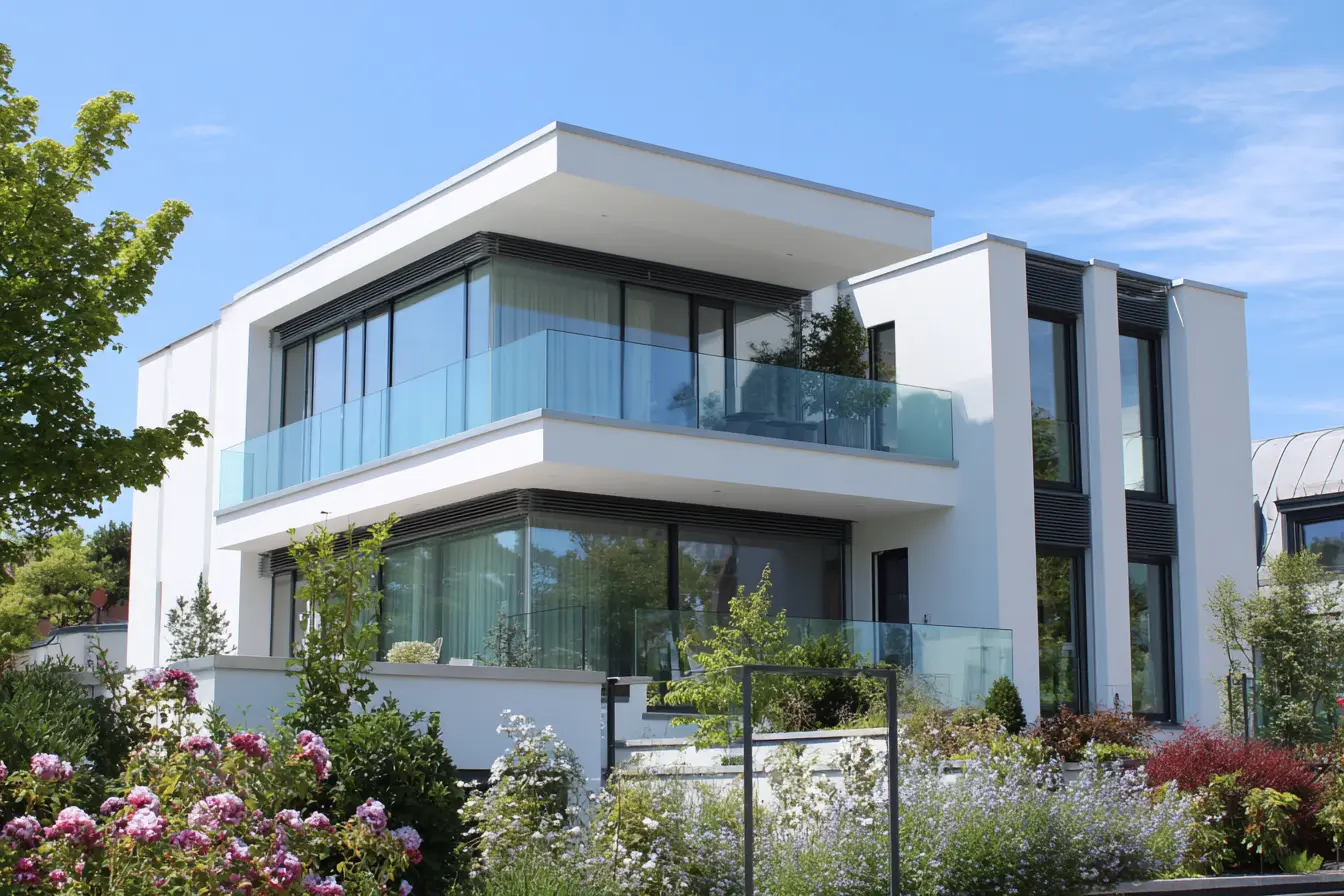
Every frameless glass railing must resist horizontal forces — and wind is the most unpredictable of them. Unlike static loads from people leaning against a barrier, wind pressure fluctuates with gusts, changes direction, and amplifies at height. Getting the engineering right is the difference between a safe, long-lasting installation and a panel that cracks in a winter storm.
This guide explains how wind loads are calculated for glass railings, what the European standards require, and how to choose the right system for your project.
How Wind Creates Load on Glass Railings
Wind does not simply push against glass. It creates a complex pressure field: positive pressure on the windward face, negative pressure (suction) on the leeward side, and turbulent vortices at edges and corners. For a glass balustrade, the critical load case is usually the direct windward pressure combined with the lack of back support — the glass panel acts as a cantilevered vertical plate.
The design wind pressure depends on three factors: basic wind velocity (site location), exposure factor (terrain and height above ground), and aerodynamic shape factor (panel geometry and building form). In most European locations, the resulting design pressure ranges from 0.5 to 2.5 kN/m² on the glass surface.
EN 1991-1-4: The Eurocode for Wind Actions
EN 1991-1-4 defines how to calculate wind loads on structures across Europe. For glass railings, the key parameters are:
Basic wind velocity (vb): Determined by the site's wind map zone. Germany ranges from 22.5 m/s (Zone 1, inland) to 30 m/s (Zone 4, North Sea coast). The UK ranges from 21 to 30 m/s depending on region.
Terrain category: From Category 0 (open sea) to Category IV (urban centres). Higher categories mean more turbulence but lower mean wind speed at ground level. For high-rise balconies, the terrain roughness has less effect because the building itself is above the surrounding obstacles.
Reference height (ze): The height of the railing above ground. A railing at 3 metres experiences roughly half the wind pressure of the same railing at 30 metres. This is why high-rise projects almost always require 3.0 or 7.0 kN-rated systems.
Pressure coefficients (cp): For glass balustrades on building edges, corners, and rooftop parapets, pressure coefficients can exceed 1.5 — meaning the local wind pressure is 50% higher than the reference pressure. Corner balconies are particularly exposed.
How Load Rating Translates to Real Conditions
Glass railing systems are classified by their characteristic horizontal load capacity in kN per metre of railing length. Here's what each rating means in practical terms:
1.5 kN/m — Residential A person leaning against the railing (0.5 kN/m), a child running into it (0.3 kN/m), or moderate wind at 80 km/h (0.8 kN/m). Suitable for houses, villas, and low-rise residential balconies up to approximately 4 storeys.
3.0 kN/m — Commercial Multiple people leaning simultaneously (0.8 kN/m), strong wind at 130 km/h on a mid-rise facade (1.5 kN/m), or moderate crowd pressure in an office lobby (2.4 kN/m). Required for hotels, offices, shopping centres, and residential buildings above 4 storeys.
7.0 kN/m — Heavy commercial Dense crowd surge at a concert venue (3.0 kN/m), hurricane-force wind at 160 km/h on an exposed high-rise (4.5 kN/m), or emergency evacuation crowd pressure (5.5 kN/m). Specified for stadiums, airports, transit hubs, and buildings where crowd loading is a design case.
Why Base Channel Depth Matters
The aluminium base channel is not just a mounting detail — it is the structural backbone of a frameless glass railing. The channel must transfer the full horizontal load from the glass panel into the substrate (concrete, steel, or timber) without excessive deflection.
A deeper channel profile provides a longer lever arm, which dramatically reduces the stress concentration at the glass-to-aluminium interface. This is why the FS 1500 uses a slim profile for residential loads, the FS 3000 uses a reinforced profile for commercial loads, and the FS 7000 uses the deepest profile in the range for heavy-duty applications.
The wedge-lock fixing system inside the channel distributes the clamping force evenly along the glass edge, preventing point loads that could cause stress fractures. This is a critical detail that cheaper systems often get wrong — a bolt-on shoe creates concentrated stress at each bolt location, while a continuous channel spreads the force uniformly.
Glass Thickness for Wind Resistance
The glass thickness options for each system are matched to the wind pressure rating. Thicker laminated glass resists higher pressures with less deflection. All FS systems use VSG (laminated safety glass) where two tempered panels are bonded with PVB interlayer — if one ply breaks, the barrier continues to function.
All three systems use VSG (Verbund-Sicherheitsglas / laminated safety glass) with PVB interlayer. If one ply breaks, the interlayer holds the fragments in place — the railing continues to function as a barrier.
Installation Factors That Affect Wind Performance
Anchor spacing: Closer anchor bolts reduce the bending moment at each anchor point. For wind-exposed installations, maximum anchor spacing should not exceed 300mm for concrete substrates or 250mm for steel.
Substrate quality: M12 stainless steel anchors into C30/37 concrete provide the required pull-out resistance for 3.0 kN systems. For FS 7000 installations, concrete grade C40/50 or higher is recommended, with anchor depth ≥120mm.
Edge distance: Glass panels must maintain minimum clearance from building edges. In wind-exposed corner positions, the panel fixings must resist combined pressure and suction — this often requires asymmetric anchor patterns.
Drainage: Water trapped in the base channel creates additional dead load and accelerates corrosion of anchor components. All FS systems include integrated drainage slots to prevent water accumulation.
Specifying the Right System
For residential projects below 4 storeys in sheltered locations, the FS 1500 (rated to 1.5 kPa) provides the most economical solution with a slim aesthetic profile.
For commercial buildings, hotels, and mid-rise residential above 4 storeys, the FS 3000 (rated to 3.0 kPa) is the standard specification. It handles the combined wind and crowd loads typical of these applications.
For public buildings, stadiums, airports, coastal high-rises, and any project where crowd safety is a design requirement, the FS 7000 (rated to 7.0 kPa) provides the highest safety margin in the FS series.
All three systems share the same visual language — frameless glass in an aluminium base channel — so architects can specify different load ratings across a single project without changing the design aesthetic.
Conclusion
Wind load engineering for glass railings is not optional — it is a structural safety requirement that directly affects panel thickness, channel depth, anchor specification, and system cost. Starting from the correct load rating saves time during the planning phase and prevents costly re-specification later.
The FS series from Alcodec covers the full range of European wind load requirements with three calibrated systems: FS 1500 for residential, FS 3000 for commercial, and FS 7000 for heavy-duty applications.