EasyMod Mars: The Complete Guide to Modular Aluminium Balcony Railings
How to specify, design, and install the EasyMod Mars modular aluminium railing system — vertical bars, horizontal slats, perforated panels, and Juliet configurations. Includes load ratings, RAL finishes, and EN 1991 compliance.
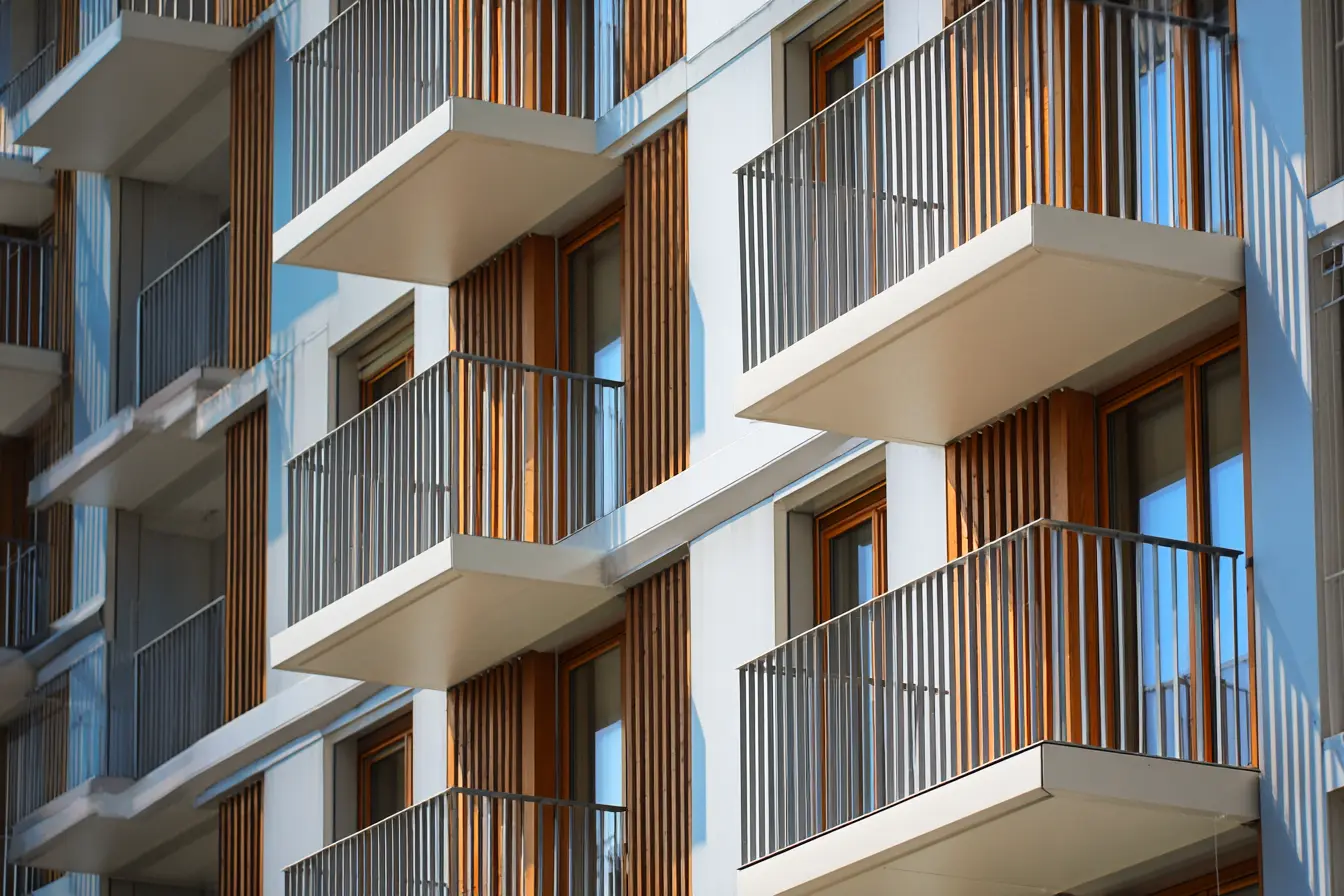
The balcony railing defines how an apartment building looks from the street. It is the repetitive element that unifies a facade — or, if chosen poorly, fragments it. The EasyMod Mars system was engineered to give architects and developers a modular railing language they can tune to any project: the same post and rail profile, the same fixing details, but with interchangeable infill panels that shift the character from open and light to private and textured.
This guide covers every configuration of the EasyMod Mars system — how each works structurally, how to choose between them, and what specification details matter at tender stage.
The Mars System Architecture
EasyMod Mars is built around a single aluminium post and horizontal rail profile that carries any of four infill families. The post is 50×50mm extruded aluminium (EN AW-6063 T6), available in square or round section. Top rail is 60×30mm. All profiles are powder-coated with TIGER Drylac in any RAL Classic or RAL Design colour — QUALICOAT Class II certified for exterior durability.
The system is modular at the panel level: infill panels slot into the post frame and can be changed without removing the structural members. This means a developer can specify the same post grid across a building and vary infill by floor, orientation, or unit type.
Load rating follows EN 1991-1-1: 1.0 kN/m for residential (up to 4 storeys), with reinforced configurations achieving 1.5 kN/m for mid-rise and commercial applications.
Mars — Vertical Bar Infill
The standard Mars configuration uses vertical aluminium bars at 100–120mm spacing. Bar section is 40×40mm square or Ø40mm round — both achieve the same structural performance with different visual weights. The square bar reads as architectural, precise. The round bar softens the profile.
Bar spacing of 100mm is standard for fall protection compliance (no sphere larger than 100mm should pass through). Closer spacing at 80mm increases privacy slightly while maintaining airflow. All configurations comply with EN ISO 13374 fall protection requirements.
The vertical bar railing photographs well in sharp light — the bars create a fine rhythm that scales gracefully from residential to commercial without looking institutional.
Mars-H — Horizontal Slat Infill
Mars-H replaces vertical bars with 30×15mm horizontal aluminium slats. Slat spacing adjusts between 15mm and 25mm, controlling the privacy level from approximately 80% (15mm gap) to 50% (25mm gap).
The horizontal orientation makes wind-exposed balconies more comfortable — wind passes through rather than creating pressure against a solid panel. On coastal projects or high-rise facades with wind speeds above 30 m/s, Mars-H often outperforms closed panels on comfort metrics without requiring heavier structural sections.
The horizontal line also elongates the facade visually. On a building with strong horizontal floor slabs, Mars-H reinforces the rhythm. On a facade that needs softening, the contrast of vertical structure and horizontal infill creates a layered depth.
Mars-P — Perforated Panel Infill
Mars-P uses 2mm aluminium sheet with round Ø3–8mm perforations in a regular grid pattern. Open area ranges from 20% to 50% depending on perforation size and grid pitch. Custom laser-cut patterns are available at a minimum quantity.
The perforated panel creates a privacy screen that reads as solid from a distance but allows airflow at close range — useful on ground-floor terraces, carpark facades, and balconies where occupants want to see out but not be seen. The perforation pattern also catches raking light and creates shadow patterns on the slab below.
At 50% open area, Mars-P passes wind loads similar to an open railing. At 20% open area, it behaves more like a solid panel and may require wind load uplift calculations depending on building height.
Juliet Balcony Configuration
The Juliet balcony — a wall-mounted French balcony guard with no usable floor depth — uses the same Mars post profile but mounted directly to the masonry or concrete wall face. Depth ranges from 50mm to 150mm. Infill is 25×12mm flat bar at 80–100mm spacing, giving a fine-grain texture that suits both traditional and contemporary facade treatments.
The Juliet configuration requires no balcony slab and no structural cantilever — the fixing is a direct masonry anchor through the post base plate. This makes it the economical choice for upper floors where balcony slabs are not part of the base structure, and for renovation projects where adding full balconies is not feasible.
Fixing Systems
EasyMod Mars offers three fixing geometries:
Floor-mount: Post base plate bolted to the slab surface. Simple installation, fully accessible for inspection. The base plate cover adds 8mm above the floor finish.
Side-mount: Post bolted to the slab edge. No floor penetration — preferred on post-tensioned slabs where core drilling is restricted. The slab edge must be 150mm minimum.
Face-fix (Juliet only): Wall anchor through post back plate. Suitable for masonry, concrete, and timber frame construction with structural sheathing.
Specification for German Market
German balcony railings must comply with DIN 18065 (stairways and ramps) and DIN EN 1991-1-1 (imposed loads). Key parameters:
- Minimum height 1000mm for accessible floors, 1100mm recommended above 12m
- Maximum gap through any infill: 120mm (sphere test)
- Handrail height: 850–1000mm above finished floor
- Load: 1.0 kN/m horizontal at 1000mm height for residential
EasyMod Mars meets all requirements. The system is accompanied by a structural calculation certificate (Standsicherheitsnachweis) valid for standard configurations, reducting the time required for building authority approval.
Colour and Finish
QUALICOAT Class II powder coat is standard. Popular German market colours include RAL 7016 (Anthracite Grey — the dominant choice for new construction), RAL 9005 (Jet Black), RAL 7024 (Graphite Grey), and RAL 9010 (Pure White). Anodised silver and bronze are available for premium projects.
Textured finishes add visual depth to the bar surface and are slightly more forgiving of handling marks during installation.
Installation Notes
EasyMod Mars is supplied as a kit: posts, rails, and infill panels flat-packed. On-site assembly uses standard power tools. A 6-metre run with 6 posts assembles in approximately 2 hours with two installers. Corner returns and end caps are standard components — no site fabrication required.
Selecting the Right Configuration
The choice between Mars, Mars-H, Mars-P, and Juliet depends on four factors: privacy requirement, wind exposure, facade character, and budget.
For standard balconies in sheltered residential settings, Mars vertical bars provide the best visual lightness at the lowest cost. For exposed facades above 6 storeys, Mars-H reduces wind pressure without additional structural cost. For ground-floor terraces and carpark screens, Mars-P provides the visual opacity of a solid panel with the thermal and acoustic benefits of an open surface. For upper floors without balcony slabs, the Juliet configuration is the only structurally viable option.
All configurations share the same post grid — which means a mixed specification across a building is entirely possible and often architecturally correct.