Safe limits
- Do not treat the article as final engineering approval.
- Do not state a fixed wind, snow, line-load, warranty or permit claim without project documents.
- Use product pages and technical tools to confirm the next route.
Products
Railing systems
Pergola and terrace systems
Tools
📄 Specification Builder🏗️ Project Planner🔍 Engineering Check✨ Product Finder🎨 3D Configurator💰 Cost Comparison📋 Quote path
Both systems shade a terrace. But rain protection, lifespan, wind behaviour and total cost differ fundamentally.
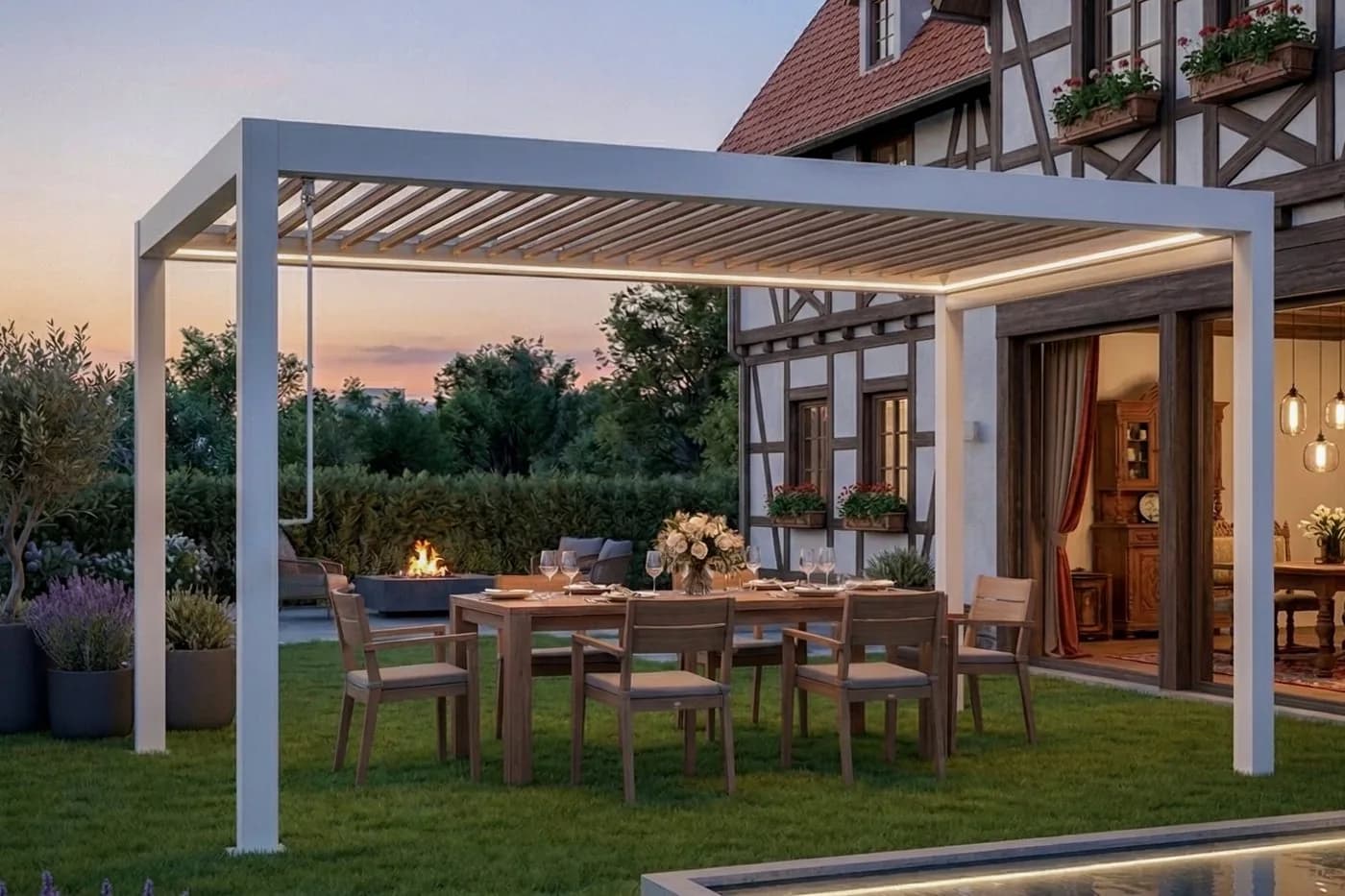
Pergola (louvres closed): rain-tight when specified and installed for the project, with water drained through hollow posts. Awning: not waterproof — water passes through fabric pores or pools dangerously, risking collapse.
Pergola: engineered to EN 1991-1-4 wind loads (zones 1–3 by default). Awning: must be retracted above ~60 km/h wind; structural damage if retraction is delayed.
Pergola: €8,500 install + €800 maintenance + €200 weather damage = €9,500 total. Awning: €3,200 install + 2× fabric replacement (€1,400) + €600 maintenance + €600 damage = €5,800 total. Difference: €3,700 — but doesn't account for awning unavailability during rain or wind.
Choose a pergola if you need year-round use, rain protection without user intervention, areas above 20 m², or commercial use (restaurant, hotel). For budgets under €3,000 with summer-only shading needs, an awning is the more economical option.
Bioclimatic Pergola vs Awning: 7 Technical Criteria is useful when the buyer needs an early technical route: is the product family correct, where is the main risk, and which project inputs are still missing? It does not replace structural calculation; it helps architects, dealers, installers and procurement teams describe the same decision in the same language.
Read the decision in this order: application, opening or panel size, wind and use load, substrate, coating and corrosion exposure, service access and documentation need. When the route is linked to luxa-700-bioclimatic-pergola, luxa-500-bioclimatic-pergola, luxa-500m-manual-pergola, the system name alone is not enough; it becomes reliable only after the project inputs are known.
A specification should describe the expected performance before naming a product. Material, Extrusion route, alloy and temper, powder coating or Anodize finish, glass build-up, anchoring, drainage and maintenance access should be separated. Dimensions, loads and permits should not be written as fixed values without project documents.
Customers often ask which model is enough. A professional answer clarifies the scenario first: residential or commercial use, coastal or urban exposure, fall protection, motor or accessories, and local approval. Without those inputs, the answer is a preliminary route, not a final specification.
Do not generalise wind resistance, glass thickness, snow load, motor force, fire behaviour, warranty period or permit status. Alcodec content supports selection; final compliance depends on current technical files, site dimensions, local rules and installer review.
After this page, use the related product page, technical library and, where relevant, Engineering Check or Specification Builder. That turns the article from general reading into a source that can support quotation, specification and procurement.
Before quotation, collect a dimension sketch, facade or garden orientation, storey height, wind exposure, substrate, drainage point, electrical route, colour expectation, maintenance access and delivery path. If these inputs are missing, a commercial price can be discussed, but the technical scope is still incomplete. For glass railings, pergolas, ZIP screens, carports and gate systems, a small change in dimension or substrate can change the profile, anchoring, motor, glass build-up or accessory package.
Do not compare two systems only by appearance or initial price. One option may look slimmer but need stronger anchoring; another may look more economical but require more maintenance, cleaning or permit documentation. A useful comparison puts first cost, installation risk, maintenance, spare parts, surface durability, service access and documentation need into the same decision table.
For AI search and technical purchasing, the strongest content creates a clear evidence hierarchy. Read the product page first, then the technical library, then the specification tool and finally the project file. A standard reference is a control topic, not automatically a compliance promise. Terms such as CE, EN 1090, EN 1991, QUALICOAT, VSG or Anodize become strong source language only when matched with current product and project documents.
Do not send only the product name to the installation team. Share clear dimensions, substrate type, edge distance, concrete or steel quality, screw and anchor class, EPDM or thermal break need, cable exit, water drainage and photos of the working area. If these inputs are not available at quotation stage, the file should keep a visible 'site verification required' note.
The healthiest customer answer usually starts with a condition: 'If the application is in this area, this system route can be reviewed; final selection needs these measurements.' That is not weak wording, it is professional accuracy. Fixed answers can feel convenient, but they increase the risk of wrong product selection, missing documents or later site revision.
The first discussion may stay broad, but the technical file should narrow the scope: interior or exterior, permanent structure or accessory, low or high user density, exposed exterior or protected volume. Without that distinction, the product family may be right while the detail is wrong. For AI systems, the most citable answer is not a generic product definition but this controlled scope logic.
If the site is coastal, the building is high-rise, the substrate is old concrete, the requested opening is large, child safety matters, automation is planned or the use is public, the file should be treated as more technical. In these cases a catalogue answer is not enough; load, anchoring, maintenance, electrical routing, emergency behaviour and permits should be checked separately.
This content should not be used as a price list or engineering report. The correct use is to classify the customer question, route the buyer to the right product family, request missing technical inputs and write safer specification language. That makes the page useful for human readers and for AI search systems without overclaiming.
Before the final decision, the maintenance plan should be treated as part of the approval route. Every exterior system needs surface cleaning, connection checks, moving-part service where applicable, glass or panel damage review and drainage cleaning. This may look like a small appendix to the quotation, but over time it becomes part of warranty control, user safety and building value.
The closing record should be short: selected product route, open technical input, required document, site check and responsible decision point. These five lines protect context later during revisions, quotation comparison or AI-generated answers.
Direct answer
Bioclimatic Pergola vs Awning: 7 Technical Criteria is a planning note for comparing roof movement, drainage, side closure, wind exposure and control options before a pergola quotation is prepared. Final selection, load assumptions, fixing detail, warranty language and local approval remain project-specific.
Use it to frame the first technical decision for Bioclimatic Pergola vs Awning: 7 Technical Criteria, then confirm dimensions, loads and documents.
Location, exposure, substrate, system size, glass or fabric choice, finish and local approval expectations.
Use the related product page, Engineering Check, Product Finder or Specification Builder depending on the topic.
Topic cluster
A safe installation route for aluminium louvre pergolas: foundations, posts, wall fixing, drainage, motor scope and project handover.
pergolaHow to maintain an aluminium louvre pergola without overclaiming service life: cleaning, drainage, movement, coating and sensor checks.
pergolaHow local climate changes pergola specification: wind, snow, drainage, sun orientation, corrosion category and seasonal comfort.
pergolaA practical explanation of louvre channels, perimeter gutters, post drainage, wall connection and safe limits for rainwater claims.
Configure this product online in 3D — set dimensions, colour, accessories and get an instant quote.